Field cards · for cameras with manual or priority modes

Your first shot came out blurry. Which one setting do you change?

Shutter speed, aperture or ISO. Three choices, a kid who won't hold still, maybe two seconds. That's usually where the camera goes back to Auto. Or where the moment ends while you're still deciding.

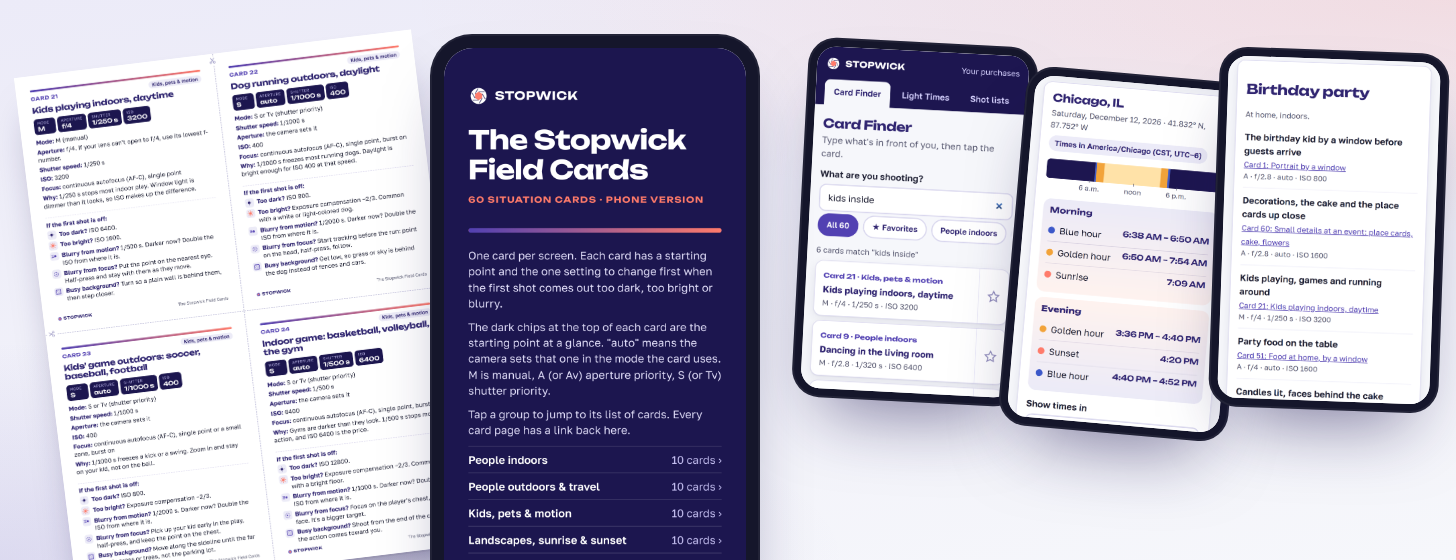
The Stopwick Field Cards answer that question before you're standing there. 60 cards, each with a starting point and the one setting to change first when the shot comes out too dark, too bright or blurry. On your phone, or printed for your bag.
A Stopwick field card on a phone screen, next to the same card printed on paper

$27 · one-time payment

Why are my indoor shots of the kids blurry?

Notes from the living room. Window light is dimmer than it looks. Kids are faster than they look. In full Auto, the camera often answers with a slow shutter, a flash, or both.

Two kinds of blurry, two different fixes. Smeared or streaked, the kid or the whole frame: motion, so the shutter needs to be faster. Soft with no streaks, while something nearer or farther is sharp: the focus missed.

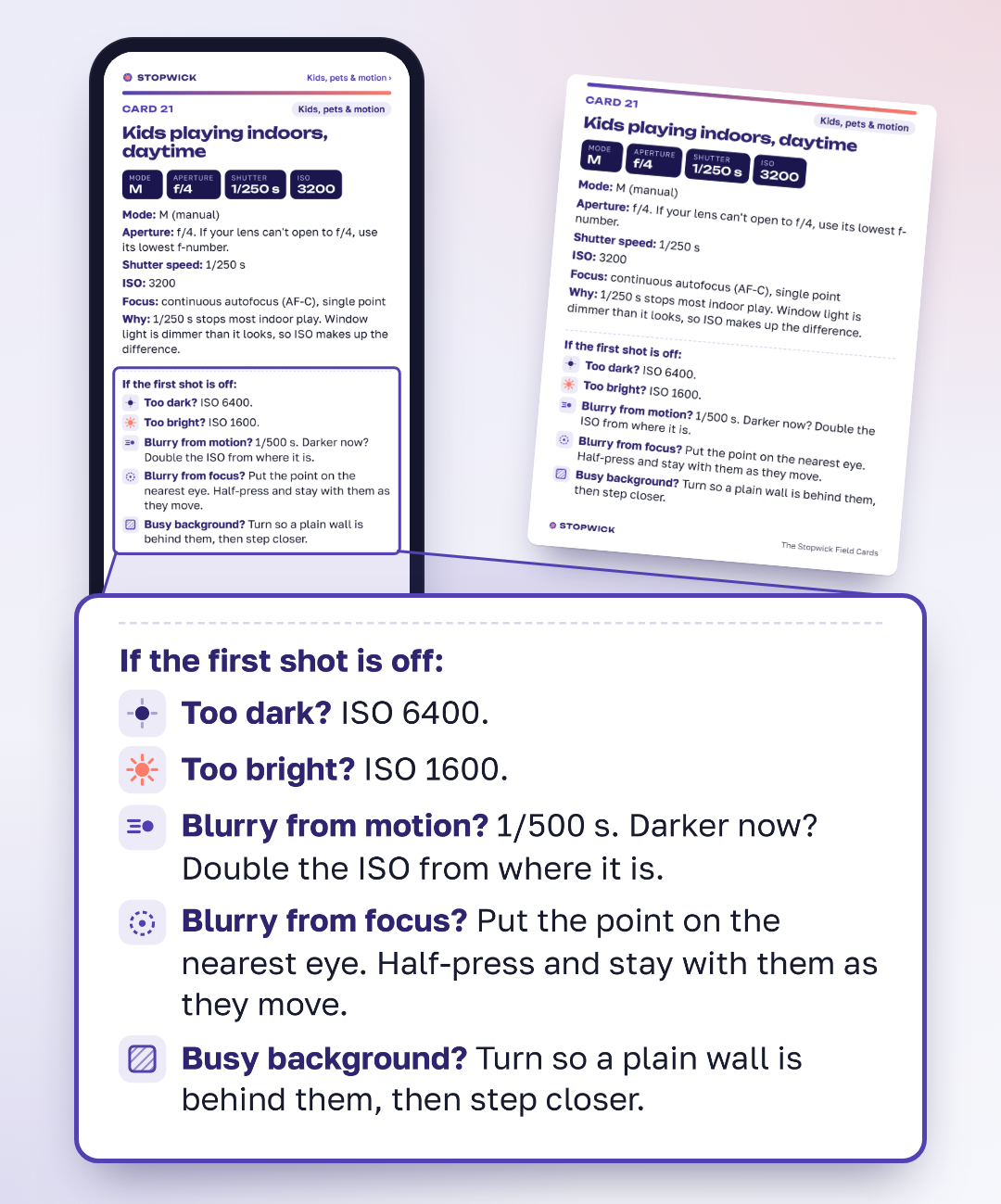
Here's the card for it, word for word.

Kids playing indoors, daytime

Kids, pets & motion

  • Mode: M (manual)
  • Aperture: f/4. If your lens can't open to f/4, use its lowest f-number.
  • Shutter speed: 1/250 s
  • ISO: 3200
  • Focus: continuous autofocus (AF-C), single point
  • Why: 1/250 s stops most indoor play. Window light is dimmer than it looks, so ISO makes up the difference.

If the first shot is off:

  • Too dark? ISO 6400.
  • Too bright? ISO 1600.
  • Blurry from motion? 1/500 s. Darker now? Double the ISO from where it is.
  • Blurry from focus? Put the point on the nearest eye. Half-press and stay with them as they move.
  • Busy background? Turn so a plain wall is behind them, then step closer.

First-Shot Correction

A settings chart gets you to the first shot. The first shot is where the light answers back: the room is darker than it looked, the dog is faster than you thought. Three dials, and nothing on the chart says which one to turn.

A starting point is half the job. The other half is knowing what to change when the first shot comes back wrong. Every Stopwick card carries both halves.

  1. Find the card for what's in front of you.
  2. Set the starting point: mode, aperture, shutter speed, ISO, focus.
  3. Take one shot. Look at it.
  4. Read the line for what you see: too dark, too bright, blurry, or a busy background.
  5. Change that one setting. Shoot again.

Still off? The fix lines are first moves from the starting point. After that, work from where you are now:

Why does the sky go white at sunset, or the ground go black?

A dark foreground, a bright sky, and a camera trying to split the difference. Usually the sky loses.

Sunset over a landscape

Landscapes, sunrise & sunset

  • Mode: A or Av (aperture priority)
  • Aperture: f/8
  • Shutter speed: the camera sets it
  • ISO: 100
  • Exposure compensation: −2/3
  • Focus: single point, on something about a third of the way into the view
  • Why: Left alone, the camera brightens the dark ground and the sky goes pale. Starting at −2/3 keeps the color in the sky.

If the first shot is off:

  • Too dark? Compensation to −1/3.
  • Too bright? Compensation to −1 1/3.
  • Blurry from motion? ISO 400. The camera will pick a faster shutter speed.
  • Blurry from focus? Move the point off the sky, onto the land a third of the way in.
  • Busy background? Step left or right until no pole or wire crosses the horizon.

Why is the dog just a blur?

A running dog, a kid on a bike, anything crossing the frame: the shutter has to beat the motion. The motion is faster than it looks.

Dog running outdoors, daylight

Kids, pets & motion

  • Mode: S or Tv (shutter priority)
  • Shutter speed: 1/1000 s
  • Aperture: the camera sets it
  • ISO: 400
  • Focus: continuous autofocus (AF-C), single point, burst on
  • Why: 1/1000 s freezes most running dogs. Daylight is bright enough for ISO 400 at that speed.

If the first shot is off:

  • Too dark? ISO 800.
  • Too bright? Exposure compensation −2/3. Common with a white or light-colored dog.
  • Blurry from motion? 1/2000 s. Darker now? Double the ISO from where it is.
  • Blurry from focus? Start tracking before the run: point on the head, half-press, follow.
  • Busy background? Get low, so grass or sky is behind the dog instead of fences and cars.

What if I can't find the card fast enough?

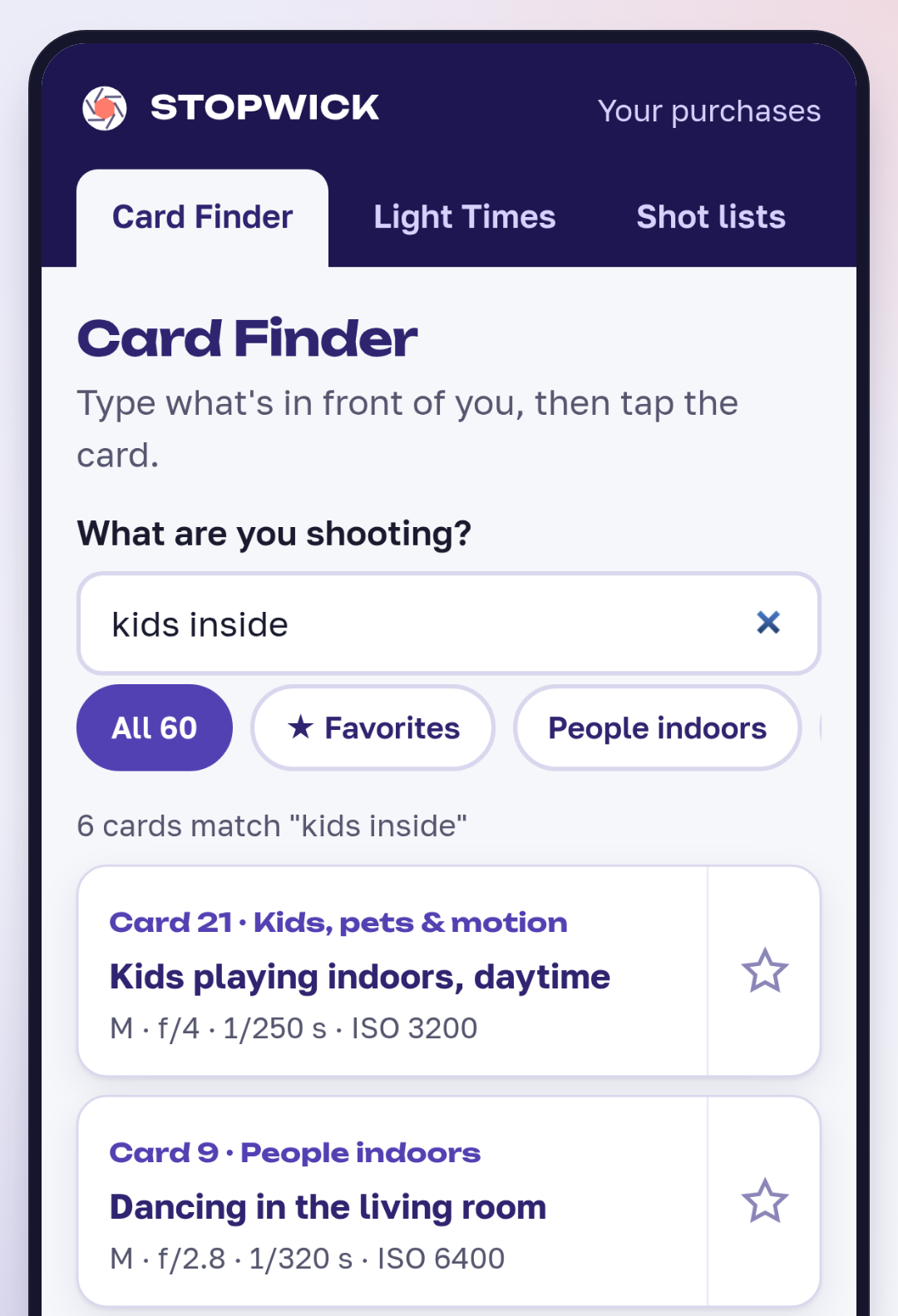
Type what's in front of you (kids inside, sunset, dog running) and the Card Finder brings up the card. Filter by group. Save the ones you use most as favorites.

The Card Finder on a phone, with "kids inside" typed in the search box and the matching card below

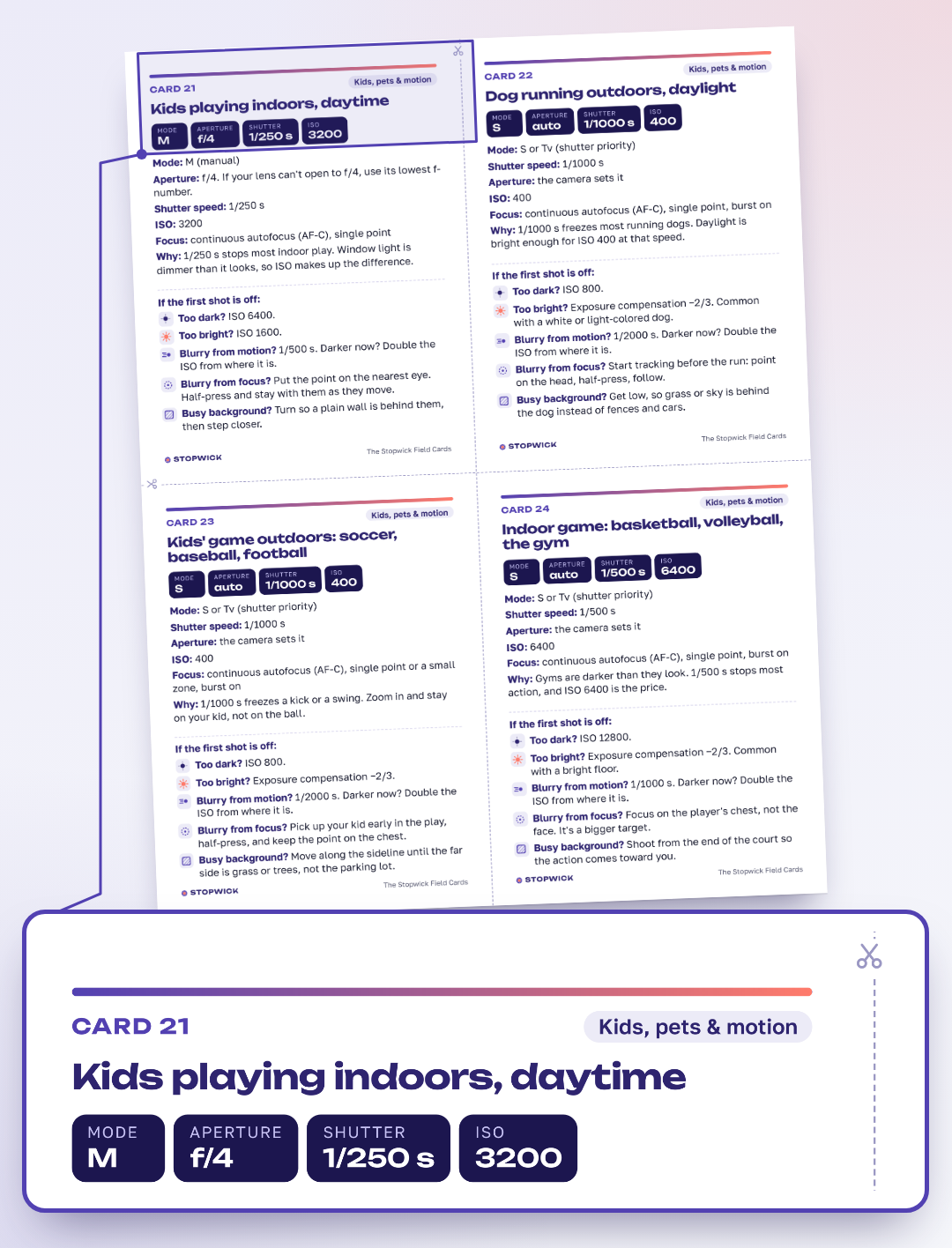
Rather have paper? Print the set: four cards to a US Letter page. Cut along the lines and keep the ones you use in your bag.

The print version: four Stopwick cards on a US Letter page, with cut lines

When is the light good where I'm going?

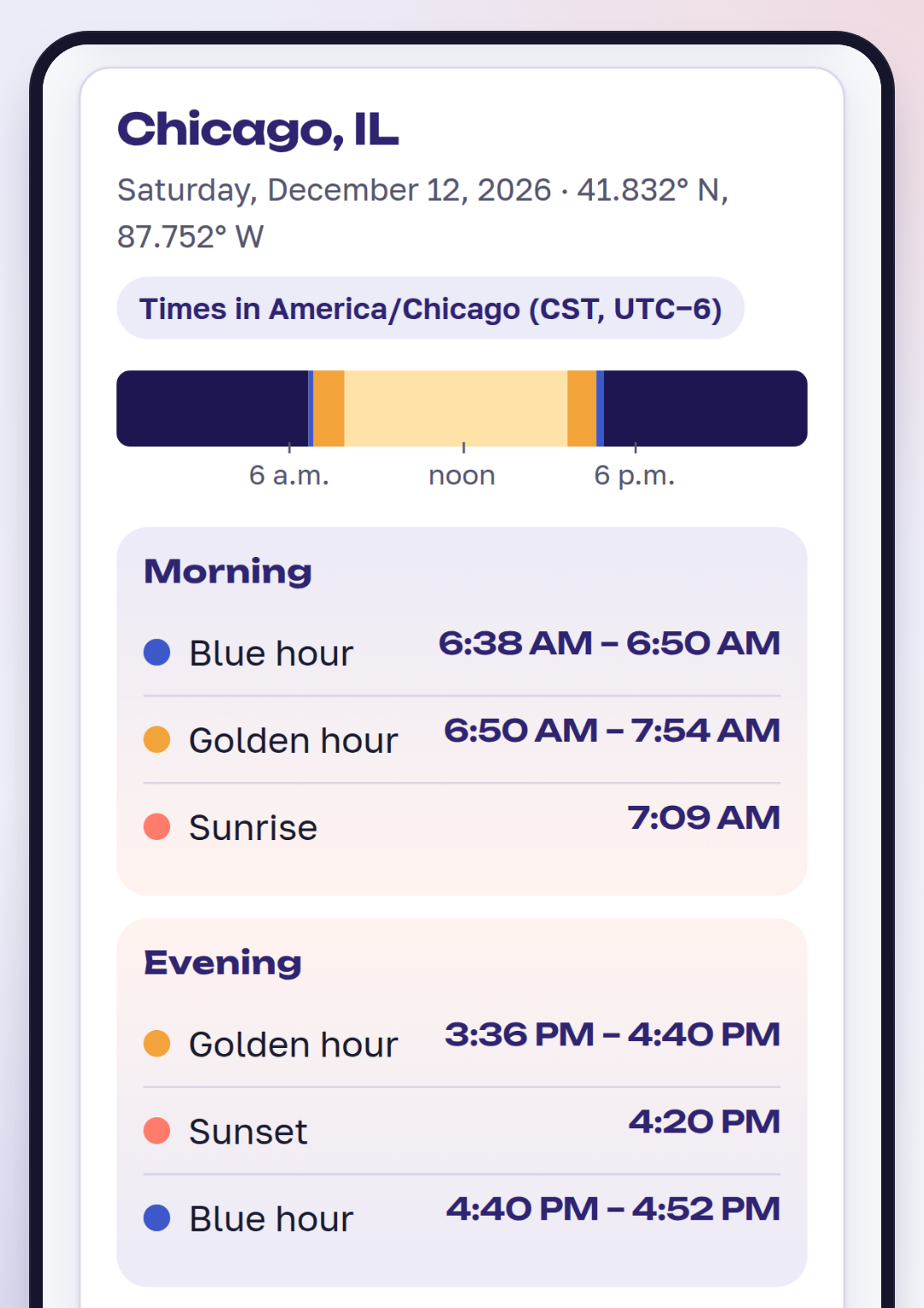
Light Times works out sunrise, sunset, golden hour and blue hour for your date and place (your phone's location, a city, or coordinates) and shows the time zone it used. The times are calculated, not observed: hills, buildings and clouds change the light you actually get.

Light Times on a phone, showing golden hour and blue hour for one date and one city

What should I shoot at the party?

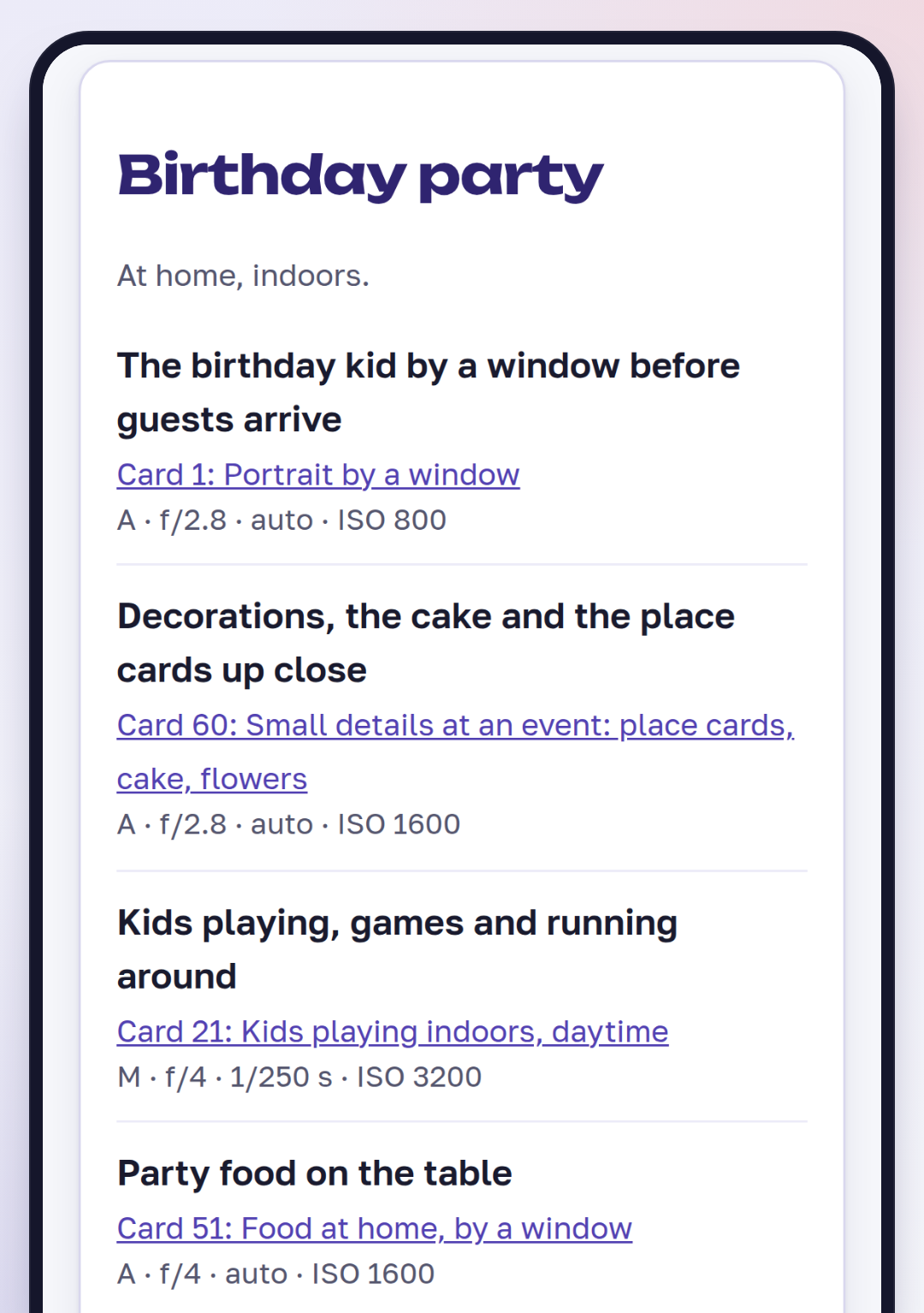
Pick the occasion (a birthday, a travel day, a holiday party, the kids' game) and the Shot-List Planner gives you a list of shots, each pointing to one of your 60 cards. Print it, or keep it on your phone.

A birthday shot list from the Shot-List Planner, with the card to use next to each shot

$27 · one-time payment

Will these work with my camera?

For cameras with manual or priority modes. If your camera has M, A (or Av) and S (or Tv) on the dial or in a menu, the cards fit. Phones without manual controls aren't covered. Menus differ by camera, so the cards name the setting, not the button.

In your camera bag

What if the cards stay in the bag?

The 30-Day Exposure. Take them on one shoot. If they're not for you, email us within 30 days. No questions asked.

30-day money-back guarantee. Email support@stopwick.shop within 30 days of purchase and we'll refund 100% of what you paid for that product. No questions asked.

How much, and how do I get them?

The Stopwick Field Cards: the phone and print PDFs, the Card Finder, Light Times and the Shot-List Planner

The Stopwick Field Cards — $27 USD, one-time payment

  • 60 situation cards, on your phone and in print
  • Card Finder, Light Times, Shot-List Planner
  • Exposure Diagrams and Start Here

One-time payment. No subscription. No recurring charges.

Instant access by email after purchase. Your downloaded files are yours to keep.

For cameras with manual or priority modes.

Stopwick gives you a starting point and a fix. Your photos are still yours to take.

$27 · one-time payment

More questions

Do I have to learn the exposure triangle first?

No. The card already did that math for the starting point. If you want the why, the Exposure Diagrams PDF shows the triangle, a table of stops, and what each setting does to a photo, one page each.

Do I have to shoot in full manual?

No. Each card names the mode to start in. Of the three cards on this page, one starts in manual, one in aperture priority and one in shutter priority.

Are there example photos?

No. This version uses diagrams, not sample photos. What you see on this page is what's in the cards.

Will these make my photos good?

They give you a place to start and the next change to make. Stopwick gives you a starting point and a fix. Your photos are still yours to take.

Who are these for?

People with a camera that has manual or priority modes, who shoot in Auto because the other modes feel like guesswork, and who'd rather learn one situation at a time. Not for phone-only shooters without manual controls, for anyone looking for a theory course, or for people who already shoot in manual without thinking about it.

Do the cards cover night shots?

The 60 cover daytime, indoor and sunset light. Night and special light (holiday lights, fireworks, the city at night, candles, a campfire, a stage) are a separate set of 15 cards, offered as an add-on when you order, for $9.

What happens to the tools later?

If we ever stop hosting the tools, we'll email you at least 60 days before and send you a copy that runs on your own computer.

New name. Why trust the cards?

Stopwick: field cards and the tools that go with them. No review history yet. Check the three cards above instead. Same words, same numbers as in the set.

What if I get stuck?

Questions about using Stopwick? Email support@stopwick.shop. We answer within 2 business days, for 12 months after your purchase.

For the next outing

Next up, maybe: the holiday table, presents opened under the lamps, the group photo before anyone leaves, a snow day. Each one has a card in the 60. Winter light goes early; Light Times gives you golden hour and sunset for your date and place.

Keep the cards on your phone and in your bag for the next time the first shot is off.

$27 · one-time payment